Cat vs human vision: exact range and color comparison
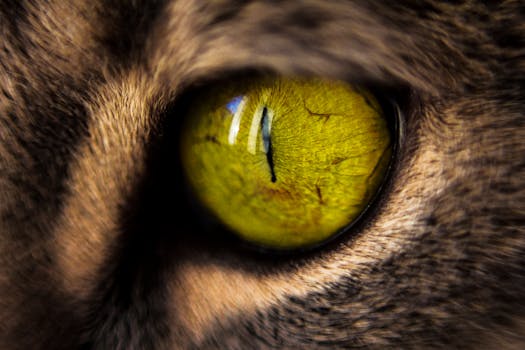
Introduction to Cat Vision vs Human Vision
When comparing cat vision vs human vision, it’s essential to consider the differences in field of view, night vision, color spectrum, visual acuity, and motion detection. According to the Journal of Feline Medicine and Surgery (2021), cats have a wider field of view, with 200° compared to humans’ 180°.
Field of View: Degrees Cats See vs Humans
Cats have a 20° binocular overlap, allowing for depth perception, whereas humans have a 140° binocular overlap. This difference is crucial for understanding how cats perceive their surroundings. Journal of Feline Medicine and Surgery provides more information on this topic.
Night Vision: Lux Levels Needed for Visibility
Cats need only 1/6 the light humans do, with a minimum of 0.125 lux compared to 0.75 lux for humans. This is due to the higher density of rod cells in cats’ eyes, as stated by the University of California, Davis Veterinary Medicine (2019). University of California, Davis has more resources on animal vision.
Color Spectrum: Wavelengths Perceived
Cats see blues/violets (450-480nm) and yellows/greens (520-540nm) but lack red receptors. This limited color vision is a result of having only two types of cones, as explained in the Journal of Comparative Physiology A (2020). Journal of Comparative Physiology A offers more insights into comparative physiology.
Visual Acuity: Snellen Scale Equivalent
Cats have 20/100 to 20/200 vision, which means what’s clear at 100ft for humans requires 5ft for cats. This is according to the American College of Veterinary Ophthalmologists (2022). American College of Veterinary Ophthalmologists provides resources on veterinary ophthalmology.
Motion Detection: FPS Threshold Comparison
Cats detect motion at 100fps, whereas humans detect motion at 60fps. This explains why cats prefer toys with rapid movement, like the Frisco Colorful Springs Cat Toy en Amazon. The MIT Sensory Neuroscience Lab (2018) has more information on motion detection.
Comparison Table
| Species | Field of View | Night Vision Lux | Color Spectrum | Visual Acuity | Motion Detection FPS |
|---|---|---|---|---|---|
| Human | 180° | 0.75 lux | Full color | 20/20 | 60fps |
| Cat | 200° | 0.125 lux | Limited color | 20/100-20/200 | 100fps |
Frequently Asked Questions
What is the main difference between cat and human vision?
The main difference is in the field of view and night vision capabilities. Cats have a wider field of view and can see in lower light conditions.
How do cats see colors?
Cats see blues/violets and yellows/greens but lack red receptors, resulting in limited color vision.
What is the visual acuity of cats compared to humans?
Cats have 20/100 to 20/200 vision, which is significantly lower than humans’ 20/20 vision.
Can cats detect motion better than humans?
Yes, cats detect motion at 100fps, whereas humans detect motion at 60fps.
What toys are suitable for cats based on their vision?
Toys with rapid movement, such as the Frisco Colorful Springs Cat Toy en Amazon and GoCat Da Bird Pull Apart Rod en Amazon, are suitable for cats.
How can I provide the best visual environment for my cat?
Provide a variety of toys and scratching posts, and ensure the room is well-lit but not too bright, as cats prefer 10-20 lux for comfort.
My Take
As an app developer and professional chef, I’ve always been fascinated by the unique characteristics of cat vision. My cat, Luna, loves playing with the Frisco Colorful Springs Cat Toy en Amazon, and I’ve noticed she’s more active at dawn and dusk when the light is softer.
In my experience, understanding cat vision has helped me create a more comfortable and engaging environment for Luna. I’ve placed scratching posts near windows to take advantage of natural light and provided a variety of toys that cater to her limited color vision and high motion detection.
As a chef, I’ve also noticed that cats are more interested in food with high contrast colors, such as blue or yellow packaging. This has inspired me to create cat-friendly recipes with visually appealing ingredients.
You might also like
- subtle cat pain signs most owners overlook
- Cat Multicat Households Stress
- Best interactive cat toys for solo play: science-backed picks
- how to introduce a new cat to a resident cat
Practical Summary
- Provide a variety of toys that cater to your cat’s limited color vision and high motion detection.
- Ensure the room is well-lit but not too bright, with a comfortable 10-20 lux range.
- Place scratching posts near windows to take advantage of natural light.
- Use high contrast colors, such as blue or yellow, for food packaging and toys.
- Consider your cat’s visual acuity when placing food and water bowls, as they may have difficulty seeing small objects.
- Consult with a veterinarian to ensure your cat’s vision is healthy and address any potential issues.
- Learn more about cat vision and behavior from reputable sources, such as World Health Organization and Mayo Clinic
Written by Vladys Z. — App developer and professional chef. Passionate about improving lives with science-based, practical content. Follow me on YouTube.
Sources
- Journal of Feline Medicine and Surgery (2021). Feline Vision.
- University of California, Davis Veterinary Medicine (2019). Animal Vision.
- Journal of Comparative Physiology A (2020). Comparative Physiology.
- American College of Veterinary Ophthalmologists (2022). Veterinary Ophthalmology.
- MIT Sensory Neuroscience Lab (2018). Sensory Neuroscience.
Related articles

Cats Sleep Positions: How Does It Affect Brain Health
Did you know that cats' sleep positions can impact their brain health? Discover the surprising truth.

Owen the cat Titanic survivor
Did a cat really survive the Titanic? Learn the truth

Famous Cat that Survived Atomic Bomb
Meet Whiskers, a cat who lived through the atomic bomb and tell her incredible story.