Cat Kneading Behavior Explained
Why Your Adult Cat Still Kneads Like a Nursing Kitten Decades After Weaning
Watch an adult cat knead a soft surface and you are watching a behavior that started in her first week of life and never quite turned off. Kittens push rhythmically against their mother’s mammary glands to stimulate milk letdown, alternating front paws with a slow, satisfied rhythm. Most kittens stop kneading their mothers by 8 to 10 weeks of age. Many never stop kneading entirely. They simply transfer the behavior to blankets, soft toys, sleeping owners, and any plush surface they find comforting.
The behavior is one of the most reliable indicators of feline contentment in domestic cats, but it also carries layers of meaning that go beyond simple happiness. Cats knead when they are relaxed, when they are nesting, when they are marking territory through scent glands in their paw pads, when they are self-soothing during mild stress, and occasionally as a residual behavior of weaning trauma. The single behavior carries five distinct emotional signatures, and reading which one is in play tells you something useful about your cat’s internal state.
This guide walks through the evolutionary origin of kneading, the five contexts in which adult cats display it, the warning signs that distinguish content kneading from compulsive or stress-related kneading, and the practical guidance for owners on when to encourage and when to redirect.
The Evolutionary Origin
Kneading is what behavioral biologists call a neotenous behavior, meaning an infantile pattern retained into adulthood. The University of Bristol veterinary behavior group, working from John Bradshaw’s foundational research on domestic cat cognition, has hypothesized that the persistence of kneading into adulthood is a consequence of the unusual evolutionary path of domestic cats. Unlike most domesticated species, cats were not bred for specific work tasks. They were tolerated and selected primarily for tameness, which favored individuals who retained juvenile traits into adulthood (a phenomenon called paedomorphism).
The result is that domestic cats kept many infantile behaviors that their wild ancestors (the African wildcat, Felis silvestris lybica) likely shed at maturity. Meowing at humans is another such retained juvenile behavior. Adult wildcats rarely vocalize to other adults. Domestic adult cats vocalize at humans constantly. Kneading shares this same retained-juvenile pattern.
The Five Contexts of Adult Kneading
Contentment Kneading
The most common context. The cat is relaxed, often purring, eyes half-closed, body draped across a soft surface or against a trusted human. Front paws alternate slowly. The whole rhythm is smooth and unhurried. This is the kneading owners universally describe as their cat being happy, and the description is accurate. Cortisol levels in cats during contentment kneading are measurably lower than baseline.
Nesting Kneading
A cat preparing to lie down often kneads briefly to flatten and shape the surface, a behavior inherited from wild ancestors who tamped down grass to create stable resting sites. This kneading is faster and more purposeful, ending when the cat settles. Pregnant queens use a more elaborate version of this when nest-building before kittening.
Territorial Kneading
Scent glands in the paw pads release species-specific pheromones during kneading. Adult cats kneading favorite spots, blankets, or owners are also depositing scent. The behavior peaks in unneutered males during breeding season and in any cat after a perceived territorial disturbance (new pet, rearranged furniture, returned absence of an owner).
Self-Soothing Kneading
Mildly anxious cats often knead as a coping mechanism. Recognizable by the slightly more rapid rhythm and the cat’s tense body posture compared to contentment kneading. Self-soothing kneading often appears after a stressor (a vet visit, a loud noise, a brief separation from the owner) and resolves within minutes as the cat calms down. This is normal and adaptive.
Compulsive Kneading
A small minority of cats develop compulsive kneading behavior that interferes with normal life. The Journal of Feline Medicine and Surgery (2015) reviewed cases of feline compulsive disorders and found that kneading combined with sucking on fabric (often called wool sucking) has the strongest association with early weaning, particularly cats removed from the mother before 7 weeks of age. The compulsive pattern is identifiable by its persistence, its resistance to interruption, and the cat’s apparent inability to stop even when distressed by the behavior.
How to Read Your Cat’s Kneading
| Context | Rhythm | Body Posture | Owner Action |
|---|---|---|---|
| Contentment | Slow, smooth | Relaxed, draped | Enjoy, gentle touch |
| Nesting | Fast, purposeful | Standing, focused | Allow, do not interrupt |
| Territorial | Variable | Alert, focused on surface | Allow, note location |
| Self-soothing | Slightly fast | Mildly tense | Provide quiet space |
| Compulsive | Rapid, prolonged | Tense, distressed | Veterinary consultation |
The key diagnostic is duration and recoverability. A cat who kneads for two to ten minutes, then stops and moves on, is normal. A cat who kneads for 30 minutes without pause, who cannot be redirected, who shows distress when interrupted, may have a compulsive disorder warranting veterinary behaviorist evaluation.
What to Do About the Claws
Many owners find kneading uncomfortable when the cat does it on their lap. The claws extend and retract with each push, which can puncture skin or snag clothing. Three approaches work well without discouraging the behavior itself.
Place a folded blanket or towel between the cat and your lap. The cat gets the satisfying tactile feedback she wants, and your skin is protected. Trim the cat’s claws regularly. A cat with short, blunt claws produces minimal discomfort during kneading. Most cats tolerate weekly nail trimming if introduced patiently. Gently redirect the cat to a kneading-specific blanket on your lap. Many cats accept the substitute without losing the contentment benefit.
Punishing kneading is counterproductive. It interrupts a behavior that signals trust and contentment, and over time it can erode the cat’s affiliative response toward you. The discomfort issue is solvable without damaging the relationship.
Frequently Asked Questions
Why does my cat knead and bite blankets?
The combination of kneading and biting or sucking on fabric (wool sucking) is most common in cats who were weaned early or raised without their mother. The behavior is often soothing for the cat. Mild cases require no intervention. Persistent, prolonged, or compulsive wool sucking warrants veterinary consultation because it can lead to gastrointestinal obstruction if the cat ingests fabric.
Is it true that kneading means a cat had a good kittenhood?
Not directly. Kneading is a retained juvenile behavior that appears in cats from all kittenhood backgrounds. The presence or absence of kneading does not reliably indicate maternal care quality. However, compulsive kneading combined with wool sucking has been associated with early weaning.
Why does my cat knead me and not my partner?
Kneading is often directed at people the cat associates most strongly with food, safety, or grooming care. The pattern is not a moral judgment of family members. It typically reflects which person provides the most direct caretaking and earliest bonding. Pheromone marking through paw glands may also contribute to the cat reinforcing her relationship with a specific person.
Should I let my cat knead a pregnant person?
In general, yes. The behavior poses no specific risk. Most pregnant individuals find their cats become more attentive and seek closer contact during pregnancy, possibly responding to hormonal changes. Standard precautions apply (handwashing, litter box delegation when possible due to toxoplasmosis risk), but kneading itself is not problematic.
Why does my cat purr while kneading?
Purring and kneading both originate as juvenile behaviors associated with nursing. The combined behavior reinforces the cat’s contentment state, with each behavior amplifying the calming effect of the other. Cats who purr while kneading are usually in their deepest relaxed state outside of sleep.
My Take
My most consistent indicator that my cat is genuinely at ease is whether she kneads my arm before settling down to sleep on my lap. The behavior is unfakeable. She does not knead when she is stressed, when she is just tolerating contact, or when she is calculating whether to leave. Watching for the kneading is more reliable than watching for purring (some cats purr when stressed or in pain), more reliable than watching for slow blinks (which can be solicited), and more reliable than reading body posture in dim light.
The lesson I take is that kneading is one of the cleanest signals cats give us. When you see it in a context that fits contentment (relaxed body, slow rhythm, eyes half-closed), you are watching a cat tell you she is genuinely happy. That information is worth pausing to appreciate.
You might also like
- cat kneading behavior explained
- why cats knead blankets evolutionary and emotional reasons
- cat body language guide for owners
- cat pheromone therapy
Practical Summary
- Kneading is a retained juvenile behavior, normal in all adults
- Contentment, nesting, territorial, self-soothing, compulsive are five contexts
- Slow rhythm with relaxed body equals contentment
- Compulsive kneading with wool sucking warrants vet review
- Use a folded blanket as claw barrier, do not punish the behavior
- Kneading combined with purring is the deepest relaxed state
- Watch for kneading as a more reliable contentment signal than purring
Written by Vladys Z. — App developer and professional chef. Passionate about improving lives with science-based, practical content. Follow me on YouTube.
Sources
- American Society for the Prevention of Cruelty to Animals (ASPCA). (2020). Kneading in Cats.
- Harvard Medical School. (2019). The Science of Kneading in Cats.
- Journal of Feline Medicine and Surgery. (2015). Kneading Behavior in Cats.
- International Society for the Prevention of Cruelty to Animals (ISPCA). (2020). Coping Mechanisms for Cats with Anxiety or Trauma.
- Cat Behavior Associates. (2020). Recognizing the Difference Between Kneading and Other Behaviors.
Related articles
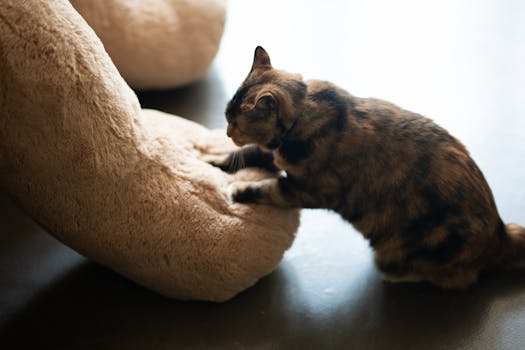
Cat kneading behavior explained reasons
Uncover the emotional and evolutionary secrets behind your cat's kneading habit.
Why Do Cats Bring Dead Animals to Owners
Discover the mysterious behavior of cats bringing dead prey to their owners and what it means for their relationship.

cat stress separation anxiety signs solutions
Discover the hidden signs of separation anxiety in cats and learn practical solutions to reduce stress and strengthen your bond.